Oops! Something went wrong while submitting the form.
By clicking "Accept", you agree to the storing of cookies on your device to enhance site navigation, analyze site usage, and assist in our marketing efforts. View our Privacy Policy for more information.
Machine Learning solutions to grow your platform's revenue & ROI
Manage player behavior using hidden data predicts without increasing traffic and marketing costs
Book a Demo
View solutions
Key facts
Every player's action holds future value. Unlock it.
×1.3 Retention Growth
×2 Conversion to VIP
-20% User churn
10-17% Uplift in GGR
Turn predictions into actions that drive measurable business results
HOW IT WORKS
MICo transforms data into accurate forecasts that deliver predictable business outcomes.
BUSINESS IMPACT
Personalize recommendations to boost engagement and retention, predict churn risks, and identify high-value audiences twice as fast.
MICo Products
Recommendation System
Replaces static game collections and manual segmentation with dynamic personalized recommendations around the operator’s business goals.
Analyzing behavioral signals from each player
Generating personalized recommendations
Dynamically updating content as player behavior evolves
Learn more
×3.7
GGR FOR THE PLAYER
+43%
retention
Player Intelligence
Optimizes communications by predicting player value and churn from their first days on the platform.
Ensuring superior communication
Enabling early detection of future VIPs
Predicts churn before it happens and proactive retention management
Segments players by predicted lifetime value
Learn more
×6
Speed of detecting VIP players
+55%
retention
From player data to smarter business decisions
Move from ML-powered predictions to the optimal action for every user
Maximize retention and LTV by making every bonus count
Manage player behavior and maximize growth with AI-powered solutions
Analyzing player behavior.
AI-powered models analyze gaming events, CRM data, and behavioral patterns to generate accurate ML forecasts and next actions.
000
-
0
Increasing platform profitability.
AI insights optimize communication strategies, marketing budgets, and the value of existing traffic.
000
-
0
No personal player data used.
Our ML models rely on non-sensitive gaming and behavioral data, not personal player data.
000
-
0
Data security guarantee.
Data processing follows strict anonymization and security requirements, compliant with ISO 27001 and GDPR.
000
-
0
Enabling fast integration.
ML solutions connect via API within 3 days, with support throughout the implementation process.
000
-
0
Our expertise
001
Expertise
80% of MICo’s ML Researchers hold PhDs in mathematics or physics, combined with experienced ML Engineers building and deploying advanced machine learning systems for global corporations.
Expertise in machine learning
We build flexible models that can be fine-tuned and adapted to an operator’s gaming data
Consistent, verifiable results
Solutions can be checked and connected to business metrics: LTV, retention, conversion, ROI, ARPU, and GGR
A case study of an operator with ~615K MAU: how to increase the value of an existing audience and drive additional GGR growth through ML personalization and personalized game recommendations, without increasing traffic volume.
Thousands of titles in a catalog do not by themselves guarantee that a player will find a game that matches their interests and gaming intent. A manually curated selection that is the same for everyone may be popular with most players while being completely irrelevant to a particular user.
But when game selection is powered by a machine learning recommendation system, the impact can go far beyond the “Recommended for You” section and affect key business metrics across the entire iGaming platform.
Project starting point: what the operator came with
An operator approached MICo with a specific goal: generate more revenue from its existing audience without increasing traffic.
The platform already had a recommendation section in the game lobby, but its content was generated using predefined rules and did not account for individual player behavior or behavioral signals.
With the operator’s permission, we break down what we changed using an ML-powered game personalization solution and what business impact it delivered.
The problem: what was wrong with the existing recommendations
The operator was expanding its game catalog and acquiring new users, but was looking for a way to generate more value specifically from its existing audience.
Even with a large selection, players did not always find content that matched their interests and playing style. A title that was popular with most users could be completely irrelevant to a particular player.
And manually creating a personalized game selection for every player is impossible.
The goal: increase commercial performance through game lobby personalization and ML recommendations, while increasing the impact of the recommendation section on key business metrics: GGR, retention, deposit activity, and LTV.
Region: CIS Audience: ~615K MAU Implementation point: “Recommended for You” section in the game lobby
What we changed and what we achieved
Solution: a personalized recommendation system instead of a rule-based approach
Instead of the standard rule-based recommendation approach, the operator implemented MICo’s Recommendation System — an ML-powered solution for personalized game recommendations in iGaming.
The system creates an individual game selection for each user based on their behavior, session history, preferences, and other parameters.
For four weeks, we compared ML recommendations with the standard rule-based approach: the control group continued receiving the predefined selection, while the test group received personalized MICo recommendations.
Result: growth in global platform business metrics
After implementing the Recommendation System, not only the recommendation section metrics improved — global metrics across the entire platform increased as well.
How the Recommendation System works
1. Evaluation and analysis
The algorithms analyze the current game catalog and available data to identify signals that can be used to personalize game recommendations.
2. Behavioral signal collection
The system collects dozens of player behavior signals: deposits and withdrawals, bets and games played, clicks, returns to games, playing pace and style, visit frequency, interactions with the recommendation section, and other behavioral patterns.
3. Candidate generation and ranking
Several independent algorithms build a pool of relevant games for each user. The final selection is then ranked with a focus on the operator’s business objectives — GGR growth, deposit activity, and retention.
The key difference from a manual approach is that instead of using one list for all players, the system considers each user’s behavior and interests and dynamically selects more relevant games based on those signals.
The operator’s team does not need to manually create and continuously update separate game selections.
Player personal data is not required to train the models.
Where else can the Recommendation System be used?
The Recommendation System can be used beyond the “Recommended for You” section.
ML-powered content personalization can be applied to search, similar-game sections, selections based on saved titles, and other points across the player journey — anywhere personalized content can influence player engagement and interaction with the platform.
This makes a recommendation system for iGaming not just a standalone UI feature, but part of a broader personalization strategy for the player experience.
What this means for the operator
Personalized recommendations are not simply a cosmetic UI improvement. They can become a tool for revenue growth and for increasing the efficiency of existing traffic.
In this case, growth was achieved without increasing traffic — solely by showing existing players more relevant content.
When players receive recommendations based on their individual behavior instead of a single manually curated list, the operator gets:
Higher engagement. More users interact with recommended games.
A better player experience. The recommendation section becomes part of the player journey rather than a static default list.
Improved business metrics. Personalization becomes an additional lever for GGR growth without increasing acquisition costs.
More value from existing traffic. Audience monetization improves without acquiring additional players.
Scaling the impact of ML personalization
The +14% figure represents a percentage of current GGR, not a fixed amount.
The larger the platform’s GGR, the greater the absolute value of the same uplift:
At €1M GGR: +14% = an additional €140K.
At €10M GGR: +14% = an additional €1.4M.
ML personalization scales with the audience: the team does not need to proportionally increase manual effort to create and update game selections.
This is not a one-time uplift, but an automated personalization mechanism that continues to operate as the audience grows.
Conclusion
The results of this case study are an important signal for iGaming operators. Simply having a recommendation section on a platform does not guarantee growth in key business metrics.
The greatest impact comes when recommendations are genuinely personalized with machine learning and take into account both player interests and behavior and the platform’s business objectives.
For an iGaming operator, this means moving from a single rule-based recommendation approach to a dynamic ML recommendation system that helps extract more value from the existing audience and turn personalization into a measurable business outcome.
VIP players are the small group that drives the platform's unit economics. They typically account for about 80% of any operator's revenue.
That said, the main challenge remains identifying them right from the start. This is critically important, since a high roller’s “lifespan” is estimated at six months, according to various sources; therefore, the sooner such a player comes to the manager’s attention, the more revenue they can generate for the platform.
Why is this opportunity often overlooked? It all comes down to a rule-based approach: the manager opens the CRM, filters the database by deposits, session frequency, and bet sizes—and then relies on their “instinct.”
This model works, but almost always with a delay: a player only comes into focus once most of their life cycle has already passed.
At the same time, simple filters often generate false positives: a player makes deposits for three days in a row, the account manager spends time and bonuses on them, but no conversion occurs.
The MICo team discovered that the necessary signals are already present in the data, but they aren't being detected in time
MICo, a developer of AI and ML solutions for iGaming, analyzed data from a number of operators and found that the behavioral patterns of future high rollers become apparent within the first few days of their activity—long before they can be detected by CRM filters.
However, with the standard approach, such signals usually go unnoticed—they manifest themselves in combinations of dozens of parameters and in the dynamics of a player’s behavior—that is, after the fact.
ML algorithms make it possible to identify such patterns much earlier, and these predictions are more accurate.
Based on this approach, MICo developed the VIP Intelligence ML solution, which identifies high-potential players as early as 3–7 days into their activity and flags them for priority follow-up by the VIP team.
In practice, the ML approach has shown improvement across all key metrics
VIP Intelligence was implemented at a CIS-based operator with an audience of over 700,000 MAUs. The impact was assessed by comparing two scenarios for how managers worked:
Standard filter — a selection of players with whom managers worked under normal conditions, without ML.
ML prioritization is a selection process in which algorithms identify players as promising starting on their third day of activity. Managers received these players on a priority list but interacted with them according to the standard procedure.
Key point: Managers did not know whether they were working with players who had been selected manually or as a result of ML prioritization.
Results from the product's first month on the market:
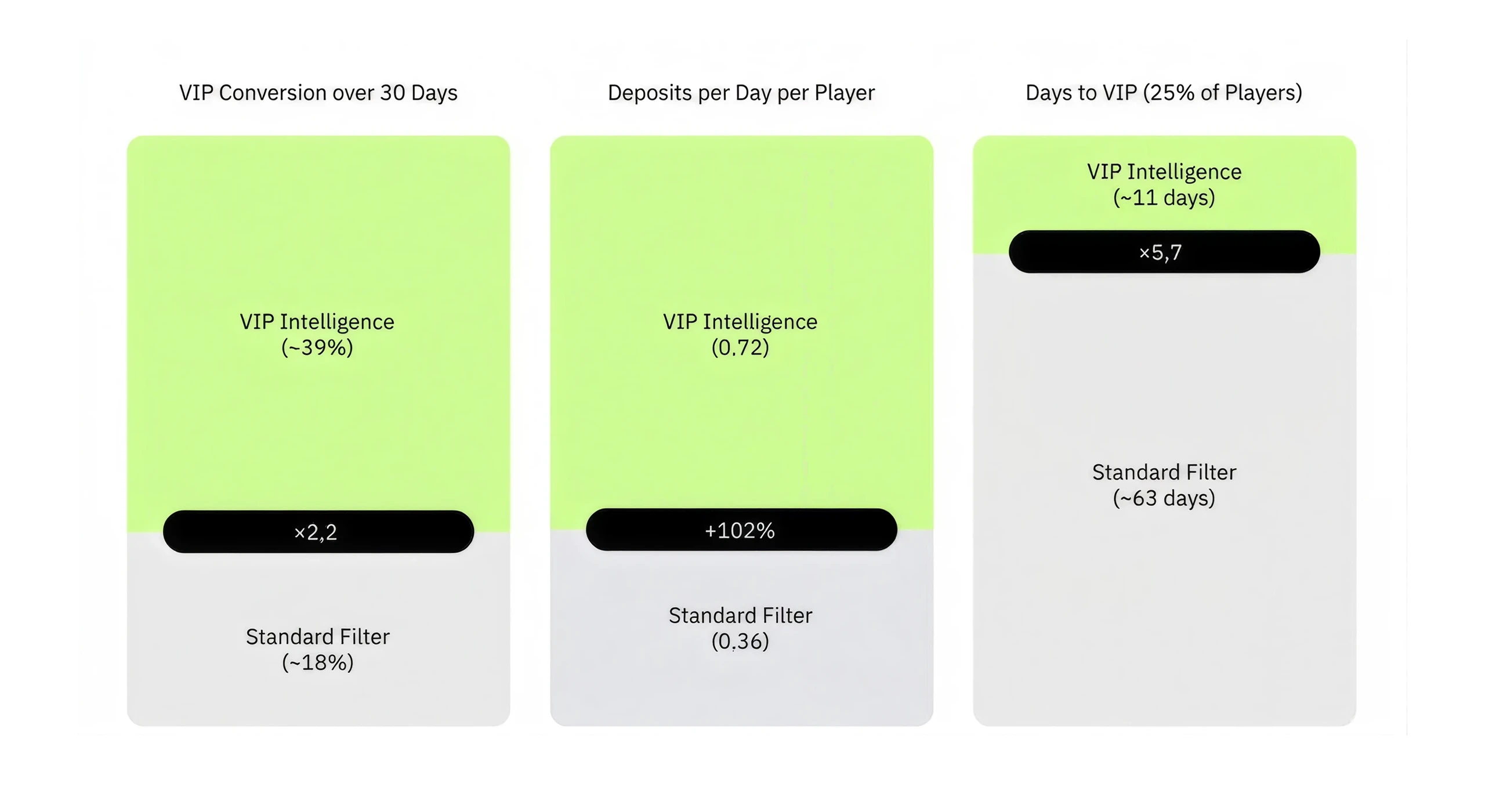
Players on the priority list reached the VIP threshold in an average of 11 days thanks to ML-based prioritization. Without ML, this figure was about 63 days.
With the implementation of VIP-Intelligence, the retention rate on the 30th day increased from 20% to 31%.
After the manager's first contact with the high roller, the player's daily NGR increased by ~30%.
VIP Intelligence analyzes hundreds of signals that cannot be processed manually
The MICo product operates as a SaaS service and can be integrated via an API or another format convenient for the operator. The ML solution begins its analysis as soon as a player logs into the platform.
In the early days, the algorithm processes behavioral signals that cannot be analyzed manually: session patterns, betting dynamics, deposit frequency, reactions to bonus mechanics, and dozens of other variables.
As a result, each player is assigned a "Confidence" score—the probability that the user will show rapid growth and become a high roller. Managers receive a prioritized list sorted by this score.
Result: The team focuses its efforts on those who are most likely to deliver real value.
Early identification of high rollers directly increases the operator's profits
Thanks to this model, players are brought into the VIP department’s spotlight three weeks earlier. This provides an additional, controllable monetization period for each high roller—without increasing acquisition costs.
The MICo solution helps identify who is currently most receptive to communications. Managers don’t waste time on those who aren’t likely to convert. In effect, this boosts the VIP department’s productivity without hiring new staff.
NGR is growing. From the moment a manager first engages with a player, daily net gaming revenue from that predicted player increases by ~30%.
For an operator with 700k+ MAU, this single product alone can help generate tens of thousands of dollars in additional revenue each month. Simply because the platform stops missing out on high rollers during their most active first few weeks.
VIP Radar can not only identify high rollers before manual selection but also assess the likelihood of their churn. This allows you to quickly develop preventive retention strategies and minimize the loss of valuable users.
The case studies address the most common questions from operators
"The ML product simply identifies those who would have brought in a lot of money anyway."
Managers did not know whether they were working with players identified by VIP Intelligence. They treated players the same way both before and after the product was implemented. The differences in deposits, conversion rates, and retention are not due to the players themselves, but rather the result of timely engagement.
"Managers can already see large deposits in the CRM"
They realize it, but it’s too late. A major operator has a user base of tens of thousands of active users, and a manager simply cannot effectively handle more than 100 people a day. 63 days to reach VIP status in a group of hand-selected players—that’s not a theoretical benchmark, but a statistical fact.
"Aggressive attention from the very first week will burn a player out faster."
The data suggests otherwise. Retention among players on the priority list reached 31% on day 30, compared to 20% without ML predictions. Early attention from a manager doesn’t burn out a player; rather, it builds their loyalty to the platform before a competitor does.
ML Prediction Is Becoming the New Standard for Working with VIP Players
The case study shows that an ML solution transforms the economics of working with high rollers not through budgets or bonus policies, but through speed. VIP-Intelligence identifies the right player from among thousands within 3–7 days—something that would be impossible to do manually.
Operators who are implementing ML today have a head start—they identify high rollers before their competitors do and earn more from each customer lifecycle.
In a few years, predictive VIP identification will become a core tool for any operator—just as CRM is today.
MICo is a full-cycle development company specializing in ML-based product solutions, with its own team of ML specialists and infrastructure for data processing and analysis. The company is certified to the international ISO 27001 standard, which attests to its high level of data security and protection.
Most iGaming operators do not lack data about players who left, they lack time to retain them. A CRM for iGaming, together with BI systems, gives operators a foundation for data collection and managing customer relationships. However, these tools alone are not enough for handling player retention at a larger scale. This is a task for AI- and ML-solutions. In the article, we’ll look at where CRM remains useful, where ML adds value, and how the two work together.
What Is a CRM in iGaming?
CRM in the iGaming industry stands for Customer Relationship Management. It is an operational environment that helps teams collect data about a company’s clients, run automated campaigns, and communicate with customers through various channels.
Depending on the platform and operator stack, CRM may also receive event data that reflects real-time behavior, predictive scores, loyalty systems, and responsible-gambling restrictions.
Core iGaming CRM Features That Drive Baseline Retention
Capabilities vary across CRM features in iGaming, but common CRM automation features include:
Creation of player segments based on behavior, value, preferences, demographic factors, and more.
Audience incentivization with bonuses, exclusive deals, and content.
Marketing automation and multi-channel communication through email, SMS, push notifications, messengers, social media, and chatbots.
Management of loyalty systems, includingtiers, points or cashback, and reward eligibility.
KYC and compliance workflow support using identity, eligibility, and restriction statuses to control player access and communications.
Where Rule-Based CRM Starts to Lose Time
A static CRM rule might trigger an action after 14 days of inactivity, when a deposit threshold is crossed, or when a player enters a VIP segment. These rules react only after a predefined condition has been met.
ML works differently. It can combine the direction and sequence of changes in session activity, deposits, betting behavior, and content preferences to estimate a future state before a single threshold has been crossed.
What iGaming Operators Need Beyond CRM
CRM marketing for iGaming can coordinate communications across the player journey once the team knows the audience, trigger, and action. Prediction becomes valuable when those answers depend on future player behavior.
MICo addresses two related but distinct tasks through two products:
Player Intelligence predicts player value and helps prioritize retention efforts;
A single session that is shorter than usual or a switch to another game category rarely says enough on its own. The predictive value comes from combinations of signals:
how deposit and withdrawal behavior evolves,
which games a player returns to,
how the user interacts with content.
ML models can learn these relationships from historical outcomes and apply them to current player activity proactively. Unlike a static segment, the model updates its estimate as the player’s observed behavior changes.
MICo's Expertise In one case study with a 700k+ MAU operator, potential high-value players were selected after three days of activity. We deployed Player Intelligence on the operator’s platform and compared the ML-selected cohort with players selected conventionally. The ML-selected cohort reached the operator’s VIP threshold in 11 days versus 63 days; D30 retention was 31% versus 20%.
Predictive Churn and VIP Detection
Churn probability is just a score. It does not suggest the next best action to prevent the player from leaving. A high score should not automatically trigger an incentive — safer-gambling, eligibility, and jurisdictional controls come first. For eligible players, the team can estimate the expected incremental response to an intervention and validate its business effect through controlled testing.
Recent retention research explicitly contrasts conventional churn-propensity targeting with uplift modeling, which estimates the effect of an intervention. A 2026 study in the International Journal of Market Research found that, in its experimental setting, uplift-based targeting produced more effective retention targeting than conventional churn and response propensity models.
Personalized Recommendations
Game discovery requires a different logic: the relevant content can vary from player to player even within the same CRM segment. MICo’s Recommendation System replaces static or manually maintained game selections with a personalized ranked list.
The model uses operator-specific behavioral, transactional, and contextual signals:
game activity,
clicks,
returns to titles,
deposits,
withdrawals,
location,
playing pace,
and player preferences.
Recommendations can be displayed in search results, homepage modules, similar-games blocks, and selections based on saved games. CRM solutions for iGaming can orchestrate player communication, while the recommendation layer ranks content inside the product.
Outcomes Brought by MICo's Solutions MICo reports that a 250k+ MAU South Asian operator replaced the selection logic in its Recommended Games block without changing the block’s design, placement, or traffic. Over the first 28 days, view-to-click conversion increased by 8 percentage points, D7 retention by 10 points, average deposit by 40%, and GGR per user within that section by 200%.
How AI and ML Transform CRM Marketing for iGaming
GenAI is already widespread in iGaming. According to UNLV and KPMG’s State of AI in Gaming 2026, 81.5% of respondents use generative AI, mainly for text and code generation, customer service, productivity, software development, and testing
Predictive ML adds a decisioning layer to CRM in the gaming industry by estimating churn risk, future player value, or likely response. Evaluation practices also remain limited: 63.9% of respondents rely on internal stakeholder feedback, 25.3% have no structured evaluation process, and only 26.5% use A/B tests or pilot comparisons. Behavioral metrics also do not capture every outcome. If player satisfaction is part of the objective, operators can complement retention and engagement data with structured player feedback.
Building the Right Tech Stack: CRM & Predictive Decisioning
Predictive capabilities can be provided through an external API, embedded natively in a CRMs for iGaming run on data from a CDP or data warehouse, or distributed across several components.
MICo trains models on each operator’s own data and aligns them with the operator’s business definitions. Player Intelligence returns player scores and priorities for CRM and VIP teams, while Recommendation System creates personalized experiences that support player engagement. Both products integrate into the operator’s existing stack and are evaluated against measurable business outcomes. Request a MICo demo to see how predictive ML can work with your data and existing CRM workflows.
AI/ML (Machine Learning) casino software covers several use cases: early VIP detection, churn prediction, Next Best Action, and personalized game recommendations for better player engagement.
In this guide, we’ll explain how each use case can increase iGaming business revenue and share tips on how to choose an AI software that fits your workflow.
What is AI casino prediction software?
AI casino prediction software is a gaming analytics tool that uses predictive algorithms to forecast player behavior. It evaluates dozens of signals, including activity patterns, deposits, bet dynamics, bonus response, and session frequency. As new behavioral data appears, the model updates each player’s potential and churn risk scores.
MICO’s Player Intelligence starts prioritizing player’s potential from the first days of activity.
AI prediction tools shouldn’t be confused with software that manipulates RNGs, odds, payouts, or gameplay. Instead, they provide CRM and VIP teams with predictive insights. Managers receive a ranked list of players who need attention before player activity and value decline.
What AI prediction software does
Algorithms in casino software perform four retention tasks:
Score players by future value.
Flag early churn risk.
Recommend the next best action.
Rank games by predicted player interest.
Player Intelligence models analyze signals such as deposits, session frequency, bet dynamics, and bonus response. Recommendation engines also use lobby and in-game behavior, including clicks, title choices, returns to specific mechanics, session pace, and play style to build a dynamic feed with multiple games for a personalized experience.
How AI models learn from player data
AI models learn from historical data: player behavior during the first sessions, return frequency, changes in deposits, player preferences, and later outcomes, such as VIP conversion or churn. The model then compares new activity with these patterns and updates its predictions as more events appear. It can estimate both the likelihood of VIP conversion or churn and the player’s interest in specific games.
Key features to look for in AI casino prediction software
Ask four questions when comparing AI casino prediction tools:
What outcome does the model predict?
Which data does it use?
How does it explain the score?
Where does the output enter the existing workflow?
These questions translate into the following features to check before choosing a tool for your iGaming business.
Early behavioral signal detection
The solution should detect shorter sessions, slower return rhythm, changing bet dynamics, bonus fatigue, longer gaps between deposits, and weaker response to manager outreach. Сombining sequential activity and aggregated player data improves prediction over using either type alone. The output should also show the changes in pattern, confidence score, along with a list of players who need attention first.
Early VIP identification
An Early Detect model should identify high-value potential before standard CRMs flag the player. In this case, VIP managers receive clear priority lists of potential VIPs earlier, which gives them more time to contact players and build relationships while their value is still growing.
MICo’s Player Intelligence starts prioritizing potential VIPs on the first days of activity.
Churn prediction
A false positive means the team spends bonus budget and manager time on a player who was unlikely to leave. A false negative can cost more in VIP retention: if the model fails to flag a high-value player in time, the team will have fewer chances to protect LTV.
Reliable prediction software should let operators evaluate model errors by business cost. The model should provide clear confidence levels, measurable precision and recall, and a workflow that prioritizes cases for CRM or VIP teams.
Player’s potential
A player value model can identify which players are worth investing in and which have reached their growth potential. This gives teams clear priorities, helping them maximize the impact of every interaction while reducing time spent on players with limited future value.
Optimization strategy
An uplift layer can turn potential or churn risk into a right communication with users:
What offer to use.
When to send it.
Which channel to choose.
Whether the player needs manager contact.
Personalized game recommendations
A Machine Learning recommendation engine should replace one static game list with a dynamic feed for each player. It uses clicks, title choices, search history, returns to game mechanics, session pace, and play style to predict interest across multiple games.
Depending on the product, the engine may use collaborative filtering, content-based logic, or a hybrid model. It forms a pool of candidate titles, combines game properties with player preferences and session context, and ranks the final selection around operator goals.
Integration with CRM and operator infrastructure
VIP and potential scores, churn risk, and game recommendations should fit into the existing CRM or VIP workflow without manual exports or extra sorting. A recommendation engine returns ranked title lists to the lobby, search, or another product section.
For smooth integration, iGaming operators need to confirm the required event data, player-ID mapping, delivery format, update frequency, and where each output will appear.
AI casino prediction software for iGaming operators in 2026
AI casino prediction software in the iGaming industry solves different retention problems.
MICo AI
MICo AI best suits operators that need early detection of VIP players and measurable retention impact. Player Intelligence analyzes dozens of behavioral signals, assigns each player a Confidence score, and gives teams a ranked priority list.
In a 700k+ MAU case, ML-prioritized players reached the VIP threshold in 11 days instead of about 63. Day-30 retention rose from 20% to 31%, and daily NGR after the first manager contact increased by about 30%.
The software works as a SaaS and integrates through an API or another operator-friendly format.
What to check before choosing an AI/ML prediction tool
Because the platforms solve different problems, start by defining the prediction target. Decide what the AI casino prediction model should do and improve:
early VIP detection,
churn-risk prioritization,
identification of player potential
manager outreach,
or the next retention action.
Once the target is clear, assess data quality. The model needs stable player IDs, clean event tracking, enough historical data, and consistent definitions of deposits, sessions, churn, and VIP status. CRM and VIP teams should also see the confidence level, key signal changes, and reasons to act on a player now.
Finally, check how the model fits the retention workflow. It should be compatible with the existing CRM, teams, and data stack without manual sorting.
Book a demo and see what your platform can achieve.
Over the last couple of years, the term "AI" has become the go-to answer to any question about technology. An algorithm selects adverts — AI. A chatbot answers questions — AI. A service recommends a film, a game or a bonus — that’s AI too.
The fact is that this term covers a range of different technologies, each with its own limitations, implementation costs and outcomes. Let’s sort out the differences once and for all.
It is important not to confuse the two: AI is not the name of a single specific technology, but rather a whole class of approaches.
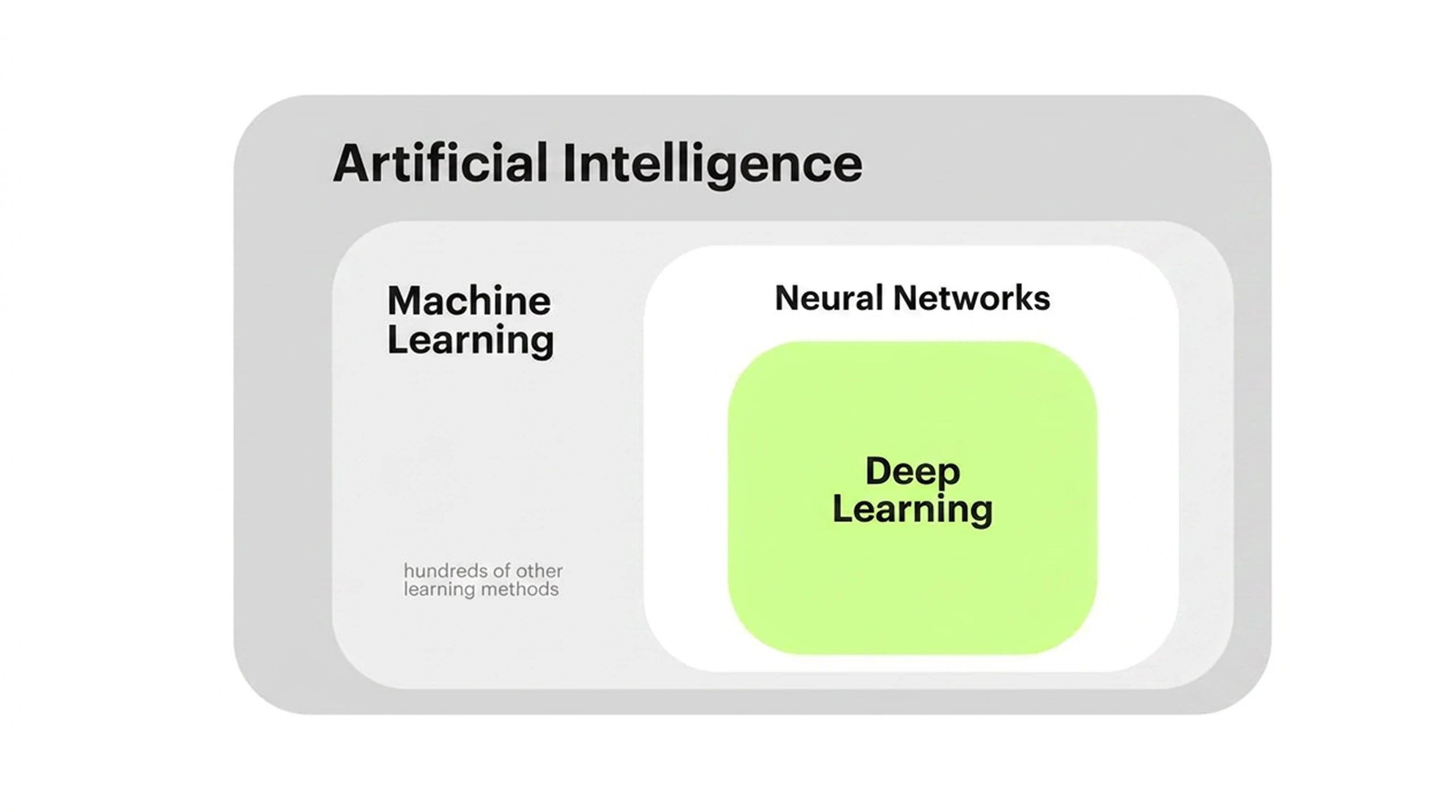
Spoiler: a neural network is one of the tools used in machine learning, and machine learning is a branch of artificial intelligence.
What is AI and how does it work?
Artificial intelligence (AI) is a general term for systems that perform tasks that typically require human involvement: recognising patterns, making predictions, taking decisions, interpreting data or interacting with users.
It sounds broad — because it really is a broad concept. Netflix, which knows that on a Friday evening you want to watch a long sci-fi film starring Actor X on your Smart TV, and on a weekday morning you want to watch a short stand-up routine by the same actor on your smartphone — that’s already AI. The developer didn’t programme the system to know this, but the system identified this connection on its own from millions of micro-interactions specifically with you, and now predicts your choices more accurately than you could articulate them yourself.
To avoid getting confused by the terminology, picture a kitchen.
The kitchen is fully equipped with all the appliances and fittings.
Machine learning (ML) is one way of cooking. It’s the most popular method today, but it’s not the only one.
Neural networks are one specific approach within machine learning. They’re trendy and powerful, but not a one-size-fits-all solution. You’ve no doubt come across this in articles discussing which neural network is best at generating content, which is best at generating images, and so on.
In short, it looks like this:
AI → ML → neural networks → deep learning
A neural network is a special case of ML. ML is a special case of AI
Why does everyone think that AI = a neural network? And what exactly is a neural network?
ChatGPT, Midjourney, Sora — every publication is writing about them. Yet an ML model that predicts player churn or assesses credit risk operates "behind the scenes", because we don’t have to make any effort (in the form of creating a prompt) to obtain the right content.
This is where the confusion lies: people see the eye-catching interfaces and the impressive results produced by even the simplest query, and start to believe that AI consists entirely of these elements.
In practice, this is not the case.
In a large number of applied problems, it is not generative models that provide the greatest value, but rather more specialised forecasting and optimisation systems.
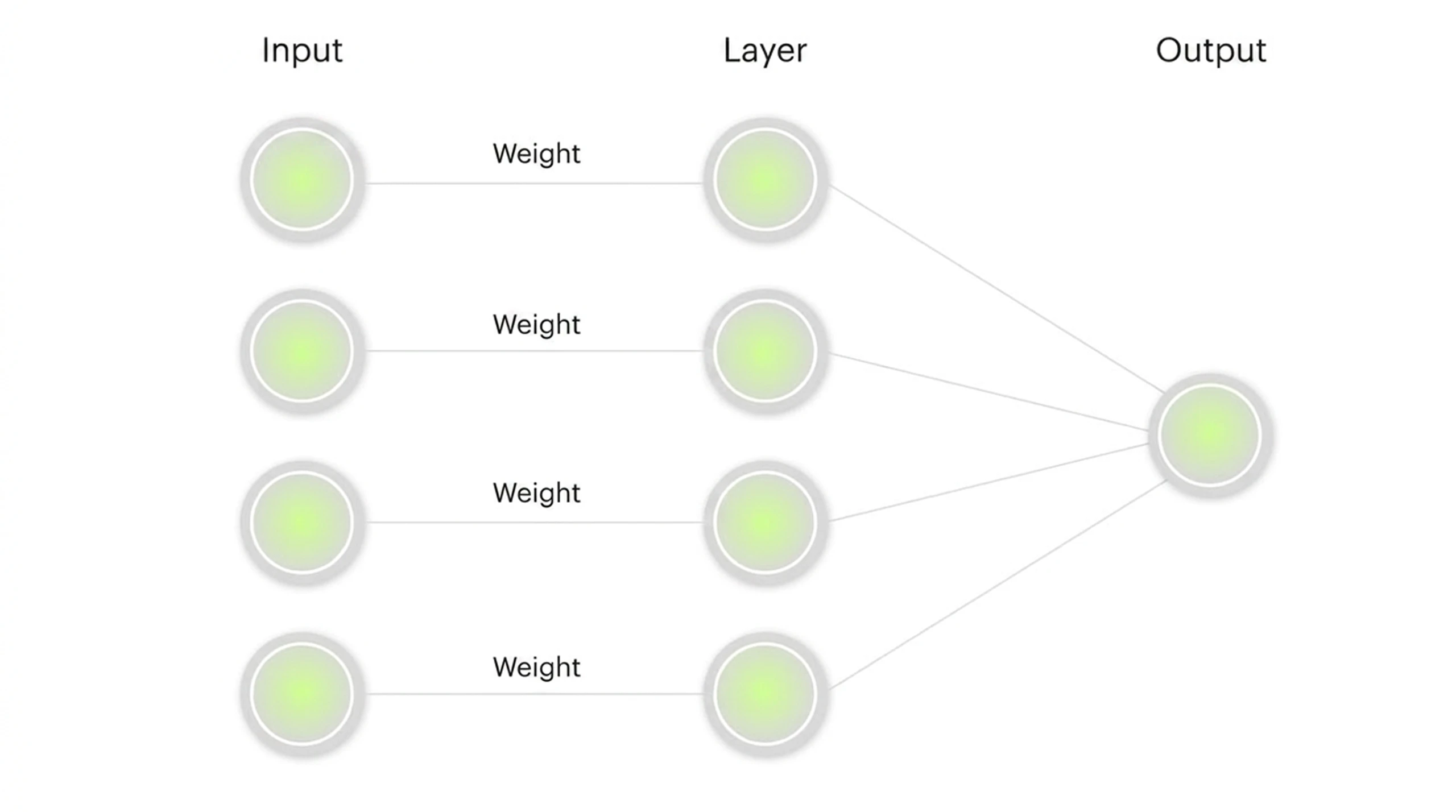
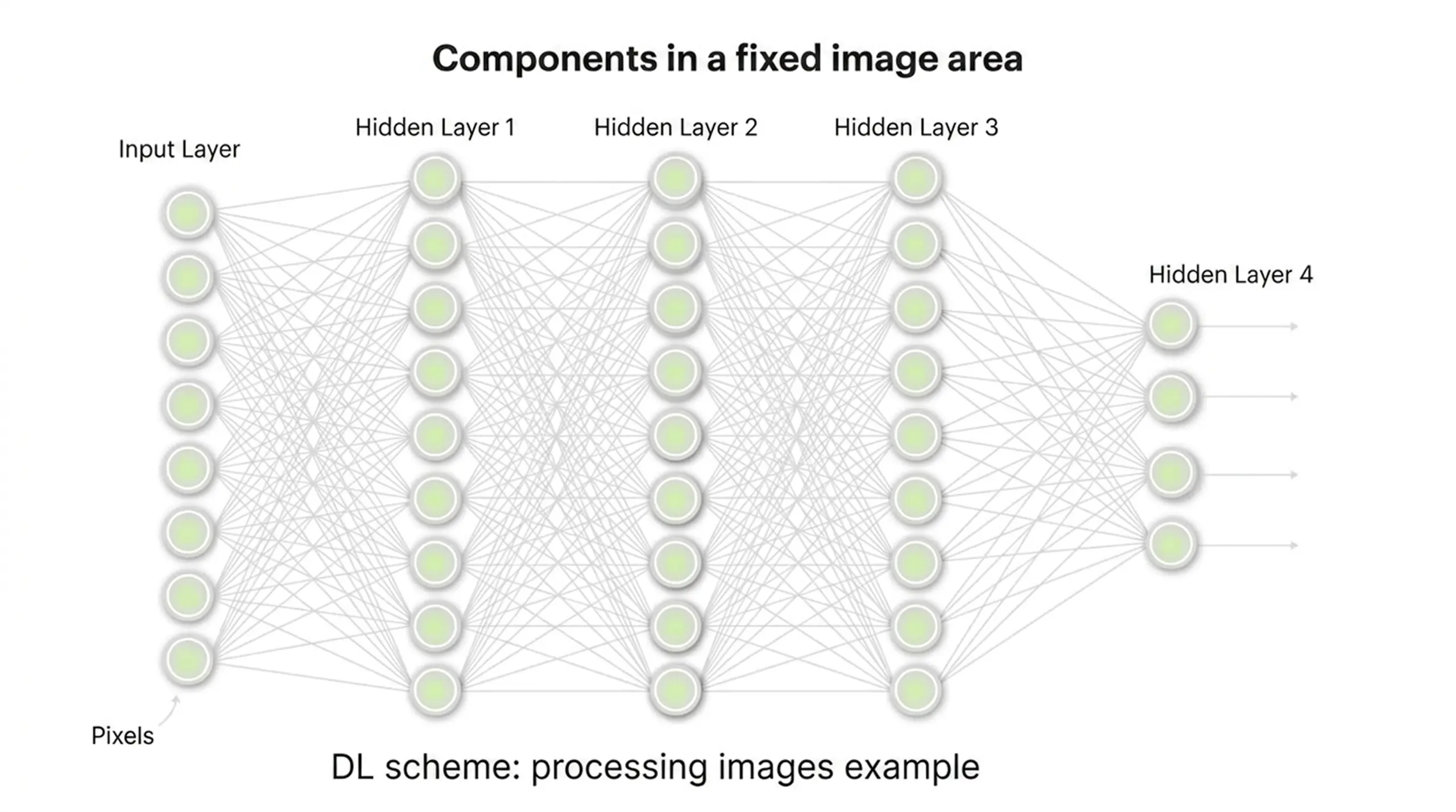
But let’s take a closer look at what this is all about. At its core lies an idea inspired by the structure of the human brain. Only, instead of a multitude of biological neurons, it uses artificial ones, organised into layers.
Each of these "neurons" receives data, processes it and passes it on through the network. During processing, the neural network identifies patterns in the input data and produces an output — for example, generated text, an image or music.
A few layers make up a neural network. A large number of layers constitute deep learning (DL). It’s the same idea, just on a different scale. This is precisely where ChatGPT and Midjourney come into their own.
Popular neural networks such as ChatGPT and DeepSeek can handle everyday, straightforward tasks involving text, images and patterns — but this is not enough for business tasks.
So what actually works, then? Let’s have a look.
ML — what it is and when it’s needed
Let’s talk about our industry — iGaming. It’s easy to confuse automation, analytics and machine learning in this field.
Where ML can help drive business growth
personalised game recommendations;
player churn prediction;
assessment of the likelihood of a deposit or repeat session;
prioritisation of players for retention;
dynamic offer selection;
identification of complex behavioural anomalies.
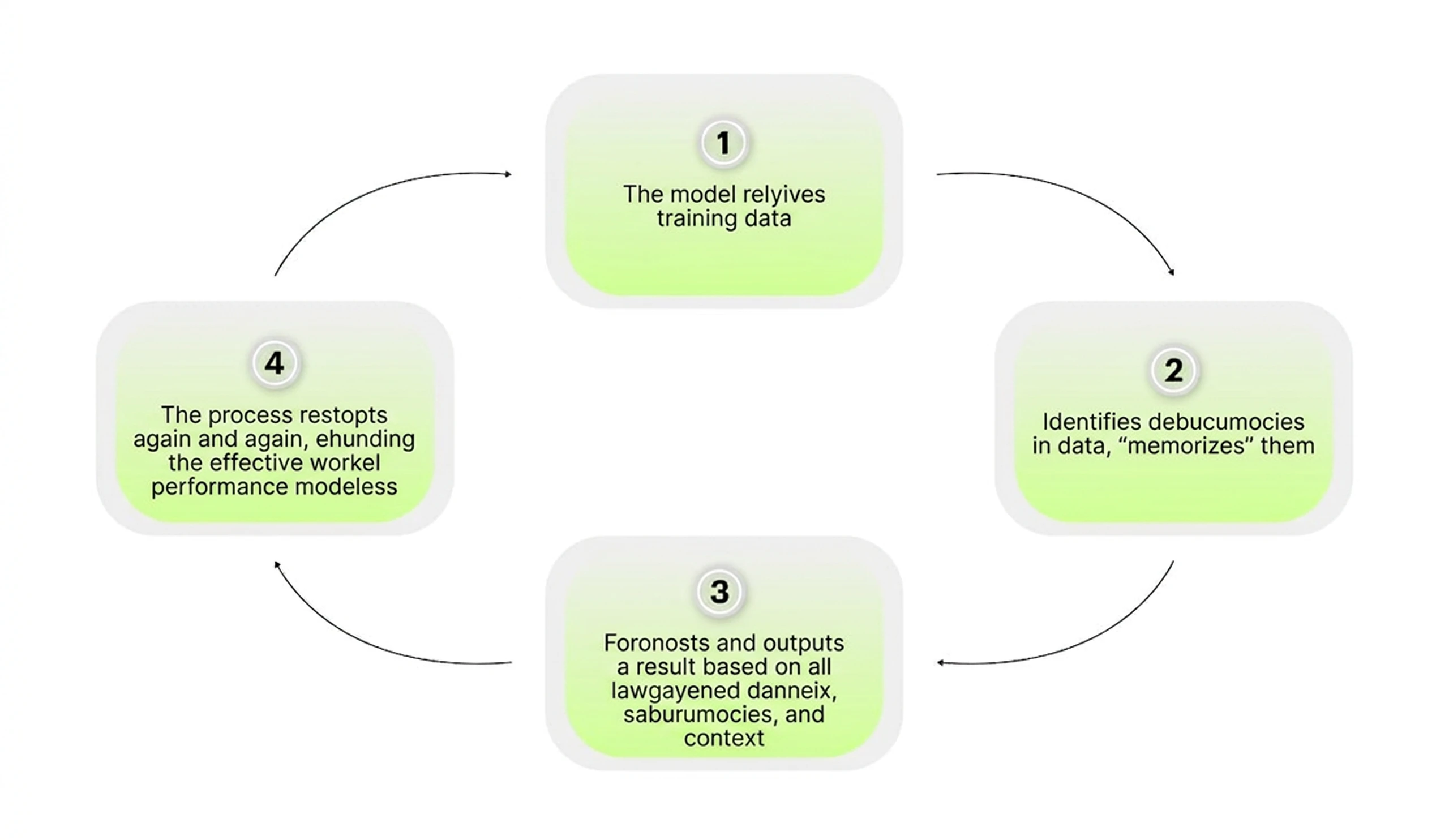
The principle is simple. You provide the model with examples: a history of player behaviour, session results, and deposit data. It looks for patterns — what do those who have left have in common? What distinguishes a future high roller from ordinary users as early as the first week? Once it has identified these patterns, the system memorises them. And when new data comes in, it makes a prediction. There’s no magic involved — just maths.
It might seem that with this approach, you could delegate all the work to a "machine", but ML isn’t always necessary. There are tasks that can be solved perfectly well using fixed rules — there’s no need to invent anything. Here’s a simple test: if a task can be solved using an if-else rule, ML is unnecessary here.
Where a "hands-on approach" is often sufficient
a bonus upon reaching a set level;
blocking of bets above the limit;
a fixed "first deposit ×2" promotion;
newsletters sent according to a pre-set schedule;
a simple list of popular games ranked by number of plays.
Other types of ML — and when they perform better than neural networks
A neural network is a powerful tool, but it is not a one-size-fits-all solution. When it comes to working with structured data, it is often other classes of ML models, rather than neural networks, that prove most effective.
The most popular of the classical algorithms are ensemble methods — where several models "vote" on the answer: Gradient Boosting and Random Forest. In iGaming industry applications, these often outperform neural networks in terms of accuracy whilst being less costly.
Classic ML algorithms. They work much like an experienced analyst using a table: they examine the features, weigh them up and produce an answer. In typical application scenarios, they often strike the best balance between data requirements, cost of use, interpretability and model accuracy.
However, for a number of problems, neural network methods are indispensable. In situations where the problem involves unstructured data or complex representations:
text;
images;
speech;
audio;
video;
content generation.
When it comes to recognising, interpreting or creating such content, neural networks are usually the obvious choice.
Choosing a method is not a matter of fashion. It is a question of the task at hand, the quality of the data, and how important it is to explain why the model arrived at a particular decision.
How this works in the real world
There are usually two images of AI in people’s minds.
AI from the films — it thinks, reasons, and is almost human. ChatGPT, which writes poetry and engages in conversation. It’s beautiful and impressive, but it’s not suitable for most business tasks.
AI from the real business world — it takes your data and says: "Players with three or more sessions a day will leave within two weeks if they don’t receive a bonus during their first session after a break. Right now, we need to offer a bonus to these players, but not to those ones".
Here at MICo, as developers of ML solutions for iGaming, we focus on the latter. This is because iGaming operators need predictable, interpretable ML — a tool whose impact can be measured in monetary terms.
The focus here is on answers to specific questions:
which players need to be retained right now;
who can be identified early on as potentially valuable;
where the marketing budget is being spent ineffectively;
which segments require different communication approaches;
which actions have the greatest impact on revenue and retention.
All materials
Frequently asked questions
What AI solutions does MICo provide for operators?
We help operators identify future VIP players, forecast churn, personalise the gaming experience and improve retention with ML models. Our solutions connect via API to your existing technology stack and begin working on the data you already hold.
This lets you launch AI initiatives faster and see a measurable effect — with no increase in marketing spend, traffic or headcount, and no in-house ML team, lengthy development or major changes to current processes.
How soon can operators see the first results from AI-driven gambling solutions?
Initial insights appear after integration and data flow starts. For Player Intelligence, early behavior patterns can be detected on days 3–7 of player activity, while prediction quality continues to improve as the model processes more operator data.
What player data do MICo’s AI-powered products analyze?
MICo works with behavioral and product data: gameplay activity, session patterns, betting dynamics, deposits, bonus response, engagement signals, game choices, clicks, and other in-platform interactions. AI in iGaming becomes more accurate when these signals are combined and updated as player behavior changes.
How can AI improve player satisfaction and loyalty in gambling?
Early signals such as segmentation, behavioral insights, VIP potential, and churn-risk detection can appear quickly after data collection begins. This is how AI can improve player satisfaction, loyalty, and gambling product performance: teams act earlier with more relevant recommendations and retention touchpoints.
Why do I need AI if I already have a CRM and BI platform?
A CRM stores player data, and BI visualizes historical performance. AI analyzes player behavior to predict churn, identify VIP potential, and recommend the next best action.
Unlike traditional analytics, AI gambling models explain every prediction, showing which factors influenced the decision. This gives operators not just forecasts, but transparent insights they can trust and act on.
How long does implementation take, and what is required to get started?
Implementation can take as little as 3 days, depending on the quality and readiness of your data.
The process is:
We assess your data for completeness and quality.
We train and configure our models based on your business goals.
We evaluate the results and then set up the regular delivery of ML predictions directly into your systems via API.
The better prepared your data is, the faster we can launch the solution and start generating actionable insights.
How reliable are your machine learning models for business decision-making?
Our machine learning models for gambling are designed to deliver reliable predictions while remaining transparent. Every prediction is accompanied by an explanation of the key factors that influenced the business outcome, allowing teams to validate recommendations instead of relying on a "black box".
Can MICo help us achieve results faster than competitors? If so, how?
Yes. While many operators are still testing AI gambling solutions and preparing their data for scale, MICo provides ML models with proven business results.
Our models are validated in real-world projects, helping improve retention, personalization, and conversion tracking—so the results we show are already achievable, not just projections.
Is MICo suitable for new operators, or is it designed only for large enterprises?
MICo is suitable for both new and established operators. The best way to understand how AI can support your business is to speak with our team.
We offer solutions for operators who are just building their MAU, as well as for mature businesses with years of historical player data. Our experts will recommend the right AI approach based on your goals, data maturity, and stage of growth.
How does MICo protect operator and player data?
MICo builds AI solutions with safer gambling requirements in mind. The company is ISO 27001 certified, meaning that the data processed remains secure and is handled according to compliance standards.
Show more
Tomorrow’s iGaming leaders will be ML-powered. Become one of them. Ready to launch?














.webp)