


Recommendation System.
Personalized ML recommendations for growing retention and revenue across gaming platforms
At the meeting, we will discuss your objectives and demonstrate how predictive models work with data in real-life scenarios
We’ll send you an email notification so you can receive our newsletter
Stay informed. Get product updates, case studies, and practical ML insights for operators.

Over the last couple of years, the term "AI" has become the go-to answer to any question about technology. An algorithm selects adverts — AI. A chatbot answers questions — AI. A service recommends a film, a game or a bonus — that’s AI too.
The fact is that this term covers a range of different technologies, each with its own limitations, implementation costs and outcomes. Let’s sort out the differences once and for all.
It is important not to confuse the two: AI is not the name of a single specific technology, but rather a whole class of approaches.
Artificial intelligence (AI) is a general term for systems that perform tasks that typically require human involvement: recognising patterns, making predictions, taking decisions, interpreting data or interacting with users.
It sounds broad — because it really is a broad concept. Netflix, which knows that on a Friday evening you want to watch a long sci-fi film starring Actor X on your Smart TV, and on a weekday morning you want to watch a short stand-up routine by the same actor on your smartphone — that’s already AI. The developer didn’t programme the system to know this, but the system identified this connection on its own from millions of micro-interactions specifically with you, and now predicts your choices more accurately than you could articulate them yourself.
The kitchen is fully equipped with all the appliances and fittings.
In short, it looks like this:
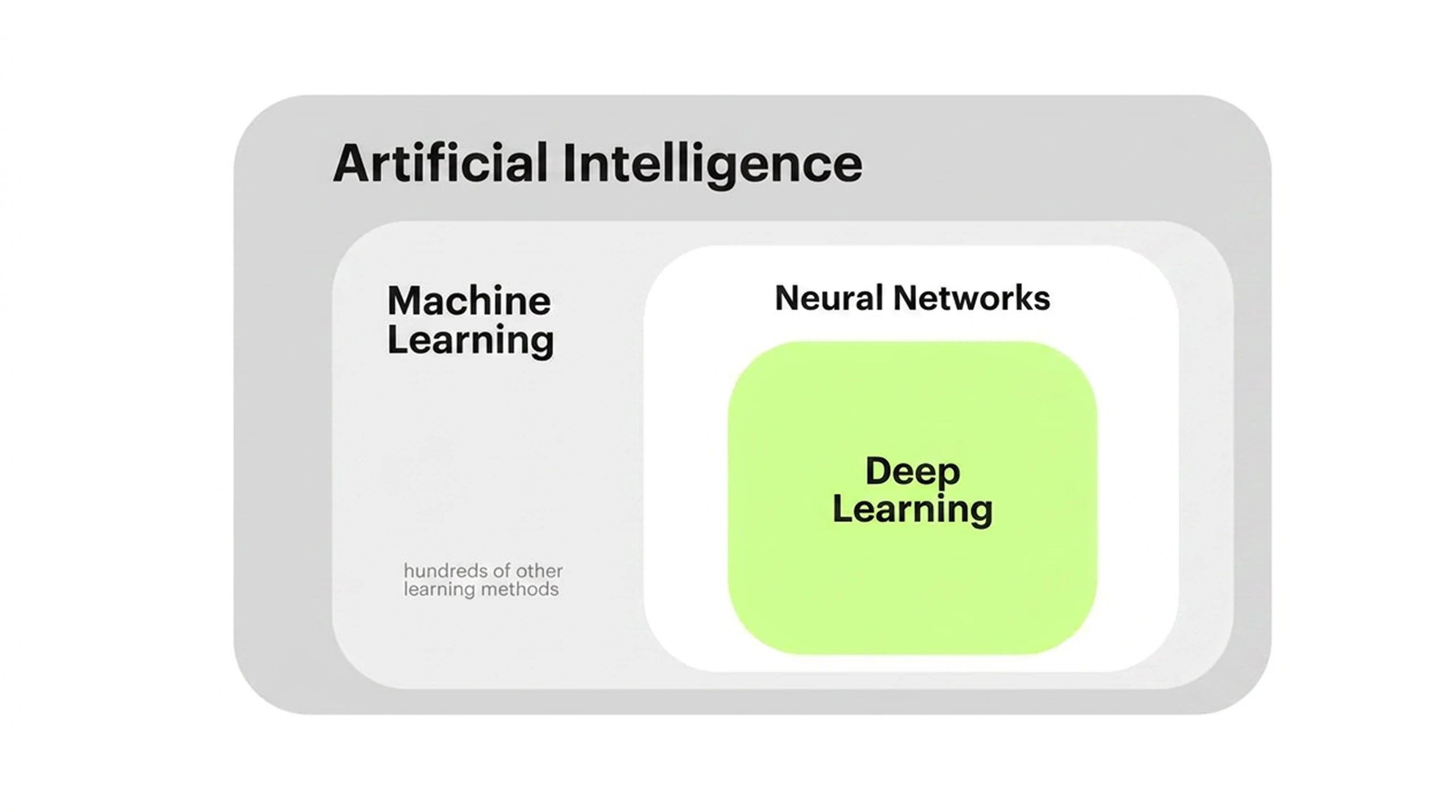
ChatGPT, Midjourney, Sora — every publication is writing about them. Yet an ML model that predicts player churn or assesses credit risk operates "behind the scenes", because we don’t have to make any effort (in the form of creating a prompt) to obtain the right content.
This is where the confusion lies: people see the eye-catching interfaces and the impressive results produced by even the simplest query, and start to believe that AI consists entirely of these elements.
In a large number of applied problems, it is not generative models that provide the greatest value, but rather more specialised forecasting and optimisation systems.
But let’s take a closer look at what this is all about. At its core lies an idea inspired by the structure of the human brain. Only, instead of a multitude of biological neurons, it uses artificial ones, organised into layers.
Each of these "neurons" receives data, processes it and passes it on through the network. During processing, the neural network identifies patterns in the input data and produces an output — for example, generated text, an image or music.
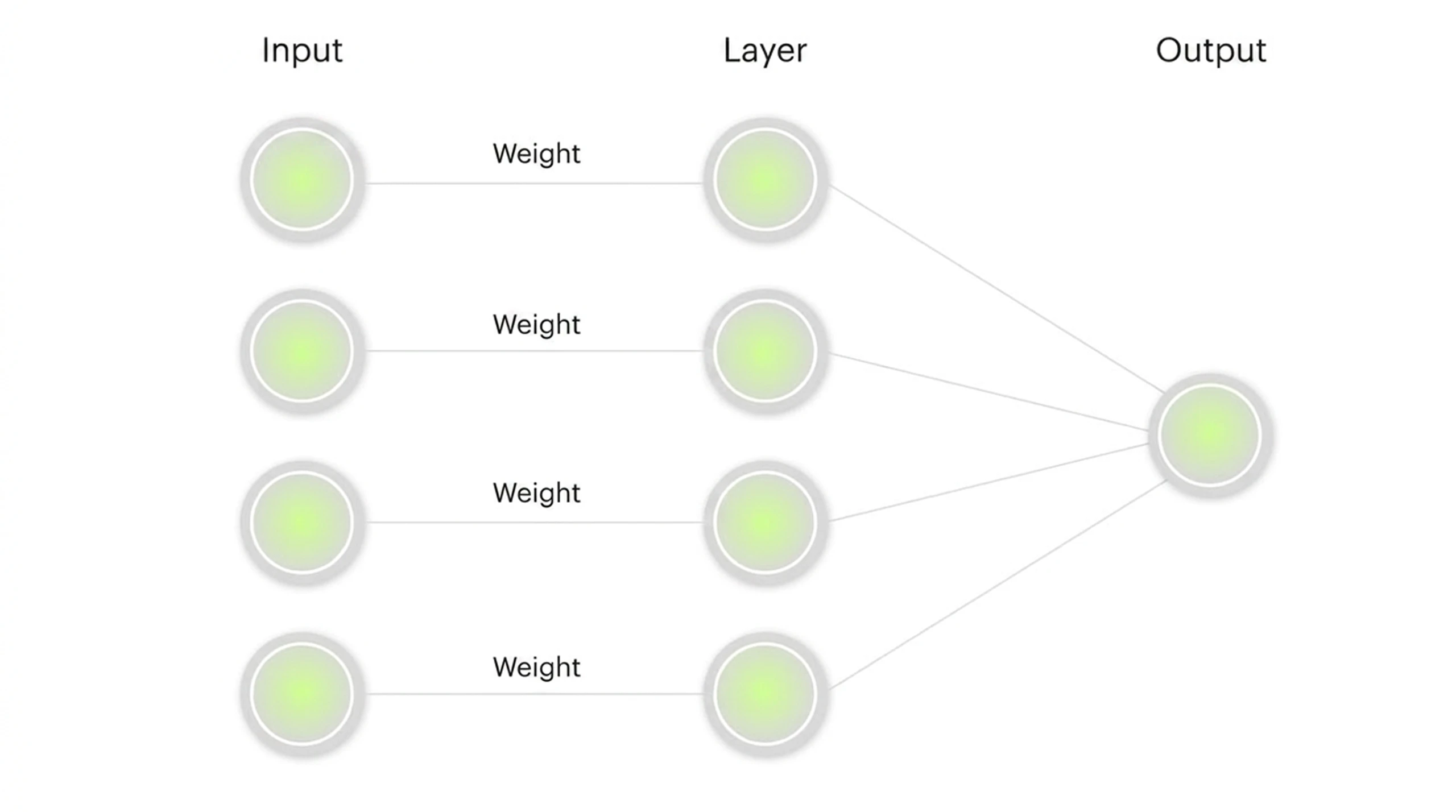
A few layers make up a neural network. A large number of layers constitute deep learning (DL). It’s the same idea, just on a different scale. This is precisely where ChatGPT and Midjourney come into their own.
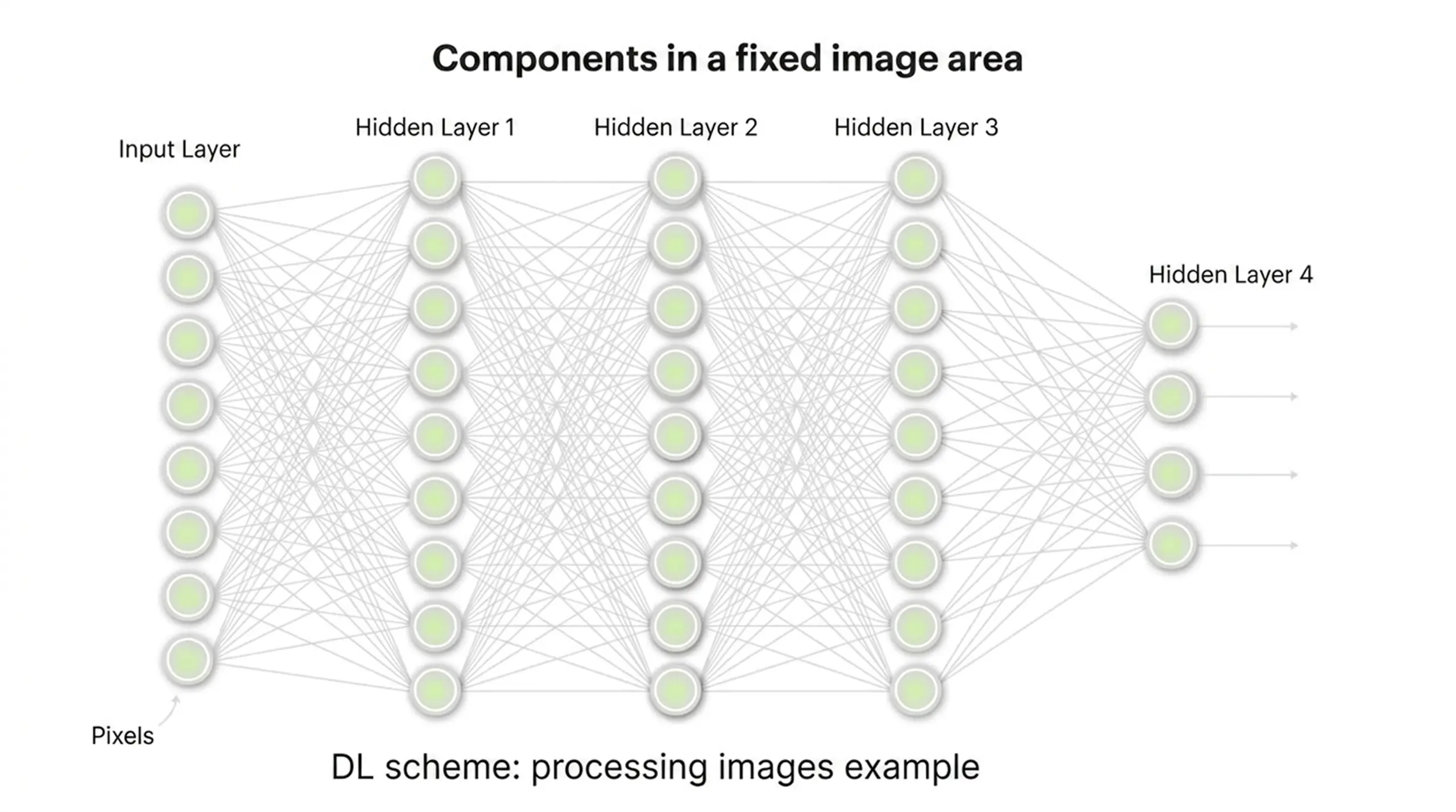
Popular neural networks such as ChatGPT and DeepSeek can handle everyday, straightforward tasks involving text, images and patterns — but this is not enough for business tasks.
So what actually works, then? Let’s have a look.
Let’s talk about our industry — iGaming. It’s easy to confuse automation, analytics and machine learning in this field.
Where ML can help drive business growth
The principle is simple. You provide the model with examples: a history of player behaviour, session results, and deposit data. It looks for patterns — what do those who have left have in common? What distinguishes a future high roller from ordinary users as early as the first week? Once it has identified these patterns, the system memorises them. And when new data comes in, it makes a prediction. There’s no magic involved — just maths.
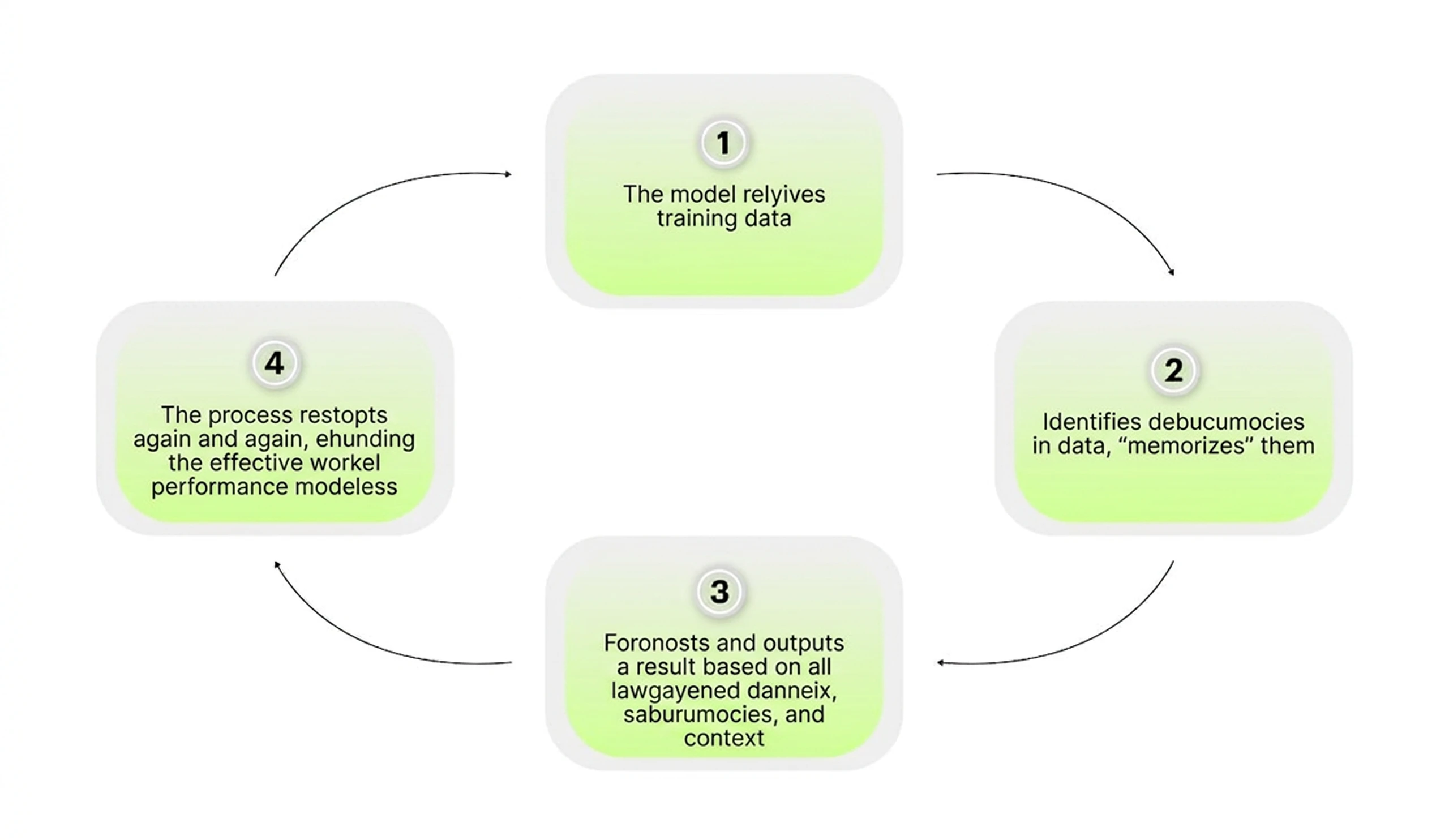
It might seem that with this approach, you could delegate all the work to a "machine", but ML isn’t always necessary. There are tasks that can be solved perfectly well using fixed rules — there’s no need to invent anything. Here’s a simple test: if a task can be solved using an if-else rule, ML is unnecessary here.
Where a "hands-on approach" is often sufficient
A neural network is a powerful tool, but it is not a one-size-fits-all solution. When it comes to working with structured data, it is often other classes of ML models, rather than neural networks, that prove most effective.
The most popular of the classical algorithms are ensemble methods — where several models "vote" on the answer: Gradient Boosting and Random Forest. In iGaming industry applications, these often outperform neural networks in terms of accuracy whilst being less costly.
Classic ML algorithms. They work much like an experienced analyst using a table: they examine the features, weigh them up and produce an answer. In typical application scenarios, they often strike the best balance between data requirements, cost of use, interpretability and model accuracy.
However, for a number of problems, neural network methods are indispensable. In situations where the problem involves unstructured data or complex representations:
When it comes to recognising, interpreting or creating such content, neural networks are usually the obvious choice.
Choosing a method is not a matter of fashion. It is a question of the task at hand, the quality of the data, and how important it is to explain why the model arrived at a particular decision.
There are usually two images of AI in people’s minds.
AI from the films — it thinks, reasons, and is almost human. ChatGPT, which writes poetry and engages in conversation. It’s beautiful and impressive, but it’s not suitable for most business tasks.
AI from the real business world — it takes your data and says: "Players with three or more sessions a day will leave within two weeks if they don’t receive a bonus during their first session after a break. Right now, we need to offer a bonus to these players, but not to those ones".
Here at MICo, as developers of ML solutions for iGaming, we focus on the latter. This is because iGaming operators need predictable, interpretable ML — a tool whose impact can be measured in monetary terms.
The focus here is on answers to specific questions: