



Recommendation System.
Personalized ML recommendations for growing retention and revenue across gaming platforms
At the meeting, we will discuss your objectives and demonstrate how predictive models work with data in real-life scenarios
We’ll send you an email notification so you can receive our newsletter
How MICo Recommendation System helped an iGaming operator increase GGR by 14% without increasing traffic through personalized game recommendations.
A case study of an operator with ~615K MAU: how to increase the value of an existing audience and drive additional GGR growth through ML personalization and personalized game recommendations, without increasing traffic volume.
Thousands of titles in a catalog do not by themselves guarantee that a player will find a game that matches their interests and gaming intent. A manually curated selection that is the same for everyone may be popular with most players while being completely irrelevant to a particular user.
But when game selection is powered by a machine learning recommendation system, the impact can go far beyond the “Recommended for You” section and affect key business metrics across the entire iGaming platform.
An operator approached MICo with a specific goal: generate more revenue from its existing audience without increasing traffic.
The platform already had a recommendation section in the game lobby, but its content was generated using predefined rules and did not account for individual player behavior or behavioral signals.
With the operator’s permission, we break down what we changed using an ML-powered game personalization solution and what business impact it delivered.
The operator was expanding its game catalog and acquiring new users, but was looking for a way to generate more value specifically from its existing audience.
Even with a large selection, players did not always find content that matched their interests and playing style. A title that was popular with most users could be completely irrelevant to a particular player.
And manually creating a personalized game selection for every player is impossible.
The goal: increase commercial performance through game lobby personalization and ML recommendations, while increasing the impact of the recommendation section on key business metrics: GGR, retention, deposit activity, and LTV.
Region: CIS
Audience: ~615K MAU
Implementation point: “Recommended for You” section in the game lobby
Instead of the standard rule-based recommendation approach, the operator implemented MICo’s Recommendation System — an ML-powered solution for personalized game recommendations in iGaming.
The system creates an individual game selection for each user based on their behavior, session history, preferences, and other parameters.
For four weeks, we compared ML recommendations with the standard rule-based approach: the control group continued receiving the predefined selection, while the test group received personalized MICo recommendations.
After implementing the Recommendation System, not only the recommendation section metrics improved — global metrics across the entire platform increased as well.
.webp)
The algorithms analyze the current game catalog and available data to identify signals that can be used to personalize game recommendations.
The system collects dozens of player behavior signals: deposits and withdrawals, bets and games played, clicks, returns to games, playing pace and style, visit frequency, interactions with the recommendation section, and other behavioral patterns.
Several independent algorithms build a pool of relevant games for each user. The final selection is then ranked with a focus on the operator’s business objectives — GGR growth, deposit activity, and retention.
The key difference from a manual approach is that instead of using one list for all players, the system considers each user’s behavior and interests and dynamically selects more relevant games based on those signals.
The operator’s team does not need to manually create and continuously update separate game selections.
The Recommendation System can be used beyond the “Recommended for You” section.
ML-powered content personalization can be applied to search, similar-game sections, selections based on saved titles, and other points across the player journey — anywhere personalized content can influence player engagement and interaction with the platform.
This makes a recommendation system for iGaming not just a standalone UI feature, but part of a broader personalization strategy for the player experience.
Personalized recommendations are not simply a cosmetic UI improvement. They can become a tool for revenue growth and for increasing the efficiency of existing traffic.
In this case, growth was achieved without increasing traffic — solely by showing existing players more relevant content.
When players receive recommendations based on their individual behavior instead of a single manually curated list, the operator gets:
The +14% figure represents a percentage of current GGR, not a fixed amount.
The larger the platform’s GGR, the greater the absolute value of the same uplift:
ML personalization scales with the audience: the team does not need to proportionally increase manual effort to create and update game selections.
This is not a one-time uplift, but an automated personalization mechanism that continues to operate as the audience grows.
The results of this case study are an important signal for iGaming operators. Simply having a recommendation section on a platform does not guarantee growth in key business metrics.
The greatest impact comes when recommendations are genuinely personalized with machine learning and take into account both player interests and behavior and the platform’s business objectives.
For an iGaming operator, this means moving from a single rule-based recommendation approach to a dynamic ML recommendation system that helps extract more value from the existing audience and turn personalization into a measurable business outcome.
VIP players are the small group that drives the platform's unit economics. They typically account for about 80% of any operator's revenue.

VIP players are the small group that drives the platform's unit economics. They typically account for about 80% of any operator's revenue.
That said, the main challenge remains identifying them right from the start. This is critically important, since a high roller’s “lifespan” is estimated at six months, according to various sources; therefore, the sooner such a player comes to the manager’s attention, the more revenue they can generate for the platform.
Why is this opportunity often overlooked? It all comes down to a rule-based approach: the manager opens the CRM, filters the database by deposits, session frequency, and bet sizes—and then relies on their “instinct.”
This model works, but almost always with a delay: a player only comes into focus once most of their life cycle has already passed.
At the same time, simple filters often generate false positives: a player makes deposits for three days in a row, the account manager spends time and bonuses on them, but no conversion occurs.
MICo, a developer of AI and ML solutions for iGaming, analyzed data from a number of operators and found that the behavioral patterns of future high rollers become apparent within the first few days of their activity—long before they can be detected by CRM filters.
However, with the standard approach, such signals usually go unnoticed—they manifest themselves in combinations of dozens of parameters and in the dynamics of a player’s behavior—that is, after the fact.
ML algorithms make it possible to identify such patterns much earlier, and these predictions are more accurate.
Based on this approach, MICo developed the VIP Intelligence ML solution, which identifies high-potential players as early as 3–7 days into their activity and flags them for priority follow-up by the VIP team.
VIP Intelligence was implemented at a CIS-based operator with an audience of over 700,000 MAUs. The impact was assessed by comparing two scenarios for how managers worked:
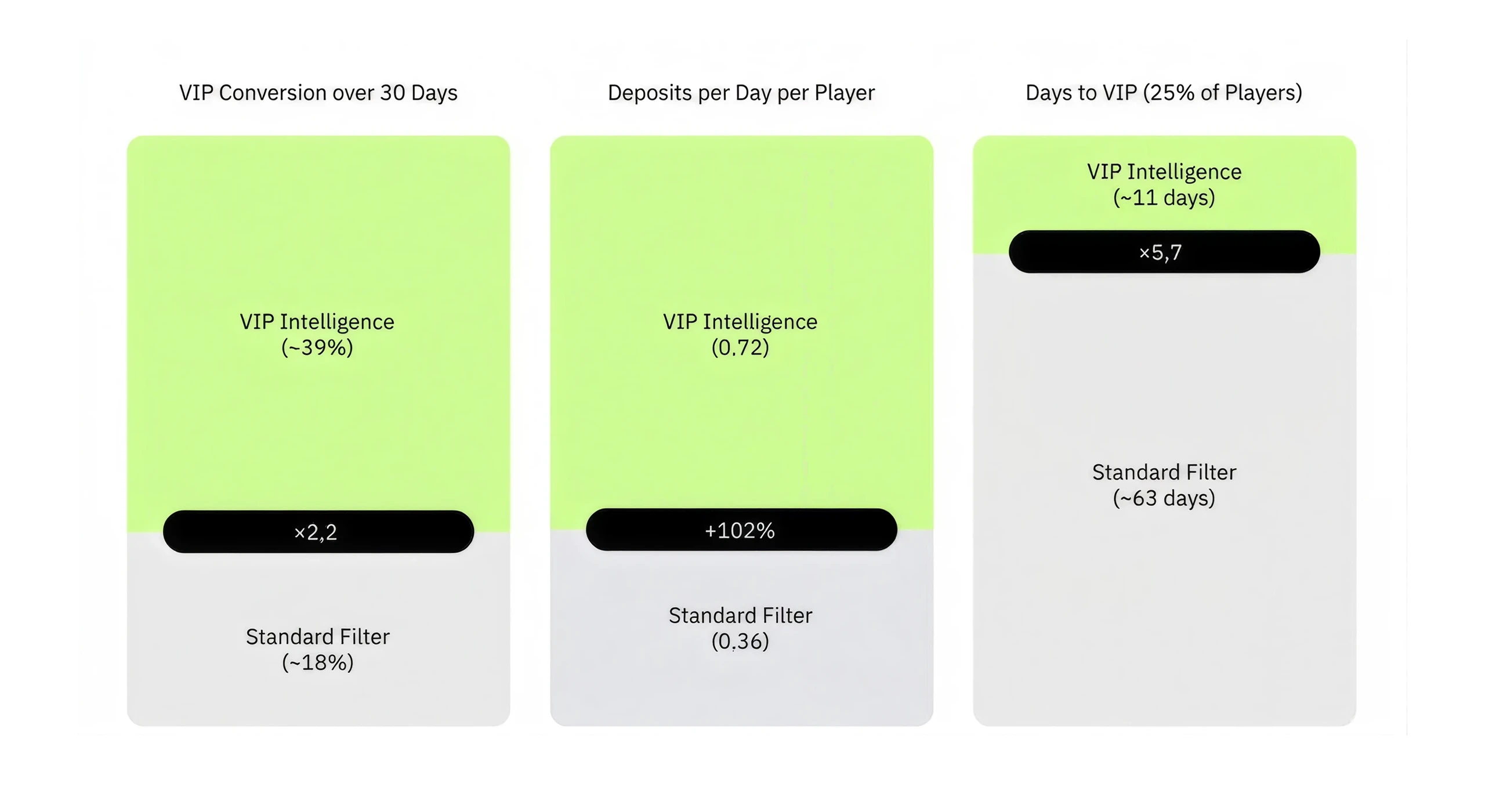
Results from the product's first month on the market:
The MICo product operates as a SaaS service and can be integrated via an API or another format convenient for the operator. The ML solution begins its analysis as soon as a player logs into the platform.
As a result, each player is assigned a "Confidence" score—the probability that the user will show rapid growth and become a high roller. Managers receive a prioritized list sorted by this score.
Result: The team focuses its efforts on those who are most likely to deliver real value.
Thanks to this model, players are brought into the VIP department’s spotlight three weeks earlier. This provides an additional, controllable monetization period for each high roller—without increasing acquisition costs.
The MICo solution helps identify who is currently most receptive to communications. Managers don’t waste time on those who aren’t likely to convert. In effect, this boosts the VIP department’s productivity without hiring new staff.
NGR is growing. From the moment a manager first engages with a player, daily net gaming revenue from that predicted player increases by ~30%.
For an operator with 700k+ MAU, this single product alone can help generate tens of thousands of dollars in additional revenue each month. Simply because the platform stops missing out on high rollers during their most active first few weeks.
VIP Radar can not only identify high rollers before manual selection but also assess the likelihood of their churn. This allows you to quickly develop preventive retention strategies and minimize the loss of valuable users.
"The ML product simply identifies those who would have brought in a lot of money anyway."
Managers did not know whether they were working with players identified by VIP Intelligence. They treated players the same way both before and after the product was implemented. The differences in deposits, conversion rates, and retention are not due to the players themselves, but rather the result of timely engagement.
"Managers can already see large deposits in the CRM"
They realize it, but it’s too late. A major operator has a user base of tens of thousands of active users, and a manager simply cannot effectively handle more than 100 people a day. 63 days to reach VIP status in a group of hand-selected players—that’s not a theoretical benchmark, but a statistical fact.
"Aggressive attention from the very first week will burn a player out faster."
The data suggests otherwise. Retention among players on the priority list reached 31% on day 30, compared to 20% without ML predictions. Early attention from a manager doesn’t burn out a player; rather, it builds their loyalty to the platform before a competitor does.
The case study shows that an ML solution transforms the economics of working with high rollers not through budgets or bonus policies, but through speed. VIP-Intelligence identifies the right player from among thousands within 3–7 days—something that would be impossible to do manually.
Operators who are implementing ML today have a head start—they identify high rollers before their competitors do and earn more from each customer lifecycle.
In a few years, predictive VIP identification will become a core tool for any operator—just as CRM is today.