



Recommendation System.
Personalized ML recommendations for growing retention and revenue across gaming platforms
At the meeting, we will discuss your objectives and demonstrate how predictive models work with data in real-life scenarios
We’ll send you an email notification so you can receive our newsletter
How MICo Recommendation System helped an iGaming operator increase GGR by 14% without increasing traffic through personalized game recommendations.
A case study of an operator with ~615K MAU: how to increase the value of an existing audience and drive additional GGR growth through ML personalization and personalized game recommendations, without increasing traffic volume.
Thousands of titles in a catalog do not by themselves guarantee that a player will find a game that matches their interests and gaming intent. A manually curated selection that is the same for everyone may be popular with most players while being completely irrelevant to a particular user.
But when game selection is powered by a machine learning recommendation system, the impact can go far beyond the “Recommended for You” section and affect key business metrics across the entire iGaming platform.
An operator approached MICo with a specific goal: generate more revenue from its existing audience without increasing traffic.
The platform already had a recommendation section in the game lobby, but its content was generated using predefined rules and did not account for individual player behavior or behavioral signals.
With the operator’s permission, we break down what we changed using an ML-powered game personalization solution and what business impact it delivered.
The operator was expanding its game catalog and acquiring new users, but was looking for a way to generate more value specifically from its existing audience.
Even with a large selection, players did not always find content that matched their interests and playing style. A title that was popular with most users could be completely irrelevant to a particular player.
And manually creating a personalized game selection for every player is impossible.
The goal: increase commercial performance through game lobby personalization and ML recommendations, while increasing the impact of the recommendation section on key business metrics: GGR, retention, deposit activity, and LTV.
Region: CIS
Audience: ~615K MAU
Implementation point: “Recommended for You” section in the game lobby
Instead of the standard rule-based recommendation approach, the operator implemented MICo’s Recommendation System — an ML-powered solution for personalized game recommendations in iGaming.
The system creates an individual game selection for each user based on their behavior, session history, preferences, and other parameters.
For four weeks, we compared ML recommendations with the standard rule-based approach: the control group continued receiving the predefined selection, while the test group received personalized MICo recommendations.
After implementing the Recommendation System, not only the recommendation section metrics improved — global metrics across the entire platform increased as well.
.webp)
The algorithms analyze the current game catalog and available data to identify signals that can be used to personalize game recommendations.
The system collects dozens of player behavior signals: deposits and withdrawals, bets and games played, clicks, returns to games, playing pace and style, visit frequency, interactions with the recommendation section, and other behavioral patterns.
Several independent algorithms build a pool of relevant games for each user. The final selection is then ranked with a focus on the operator’s business objectives — GGR growth, deposit activity, and retention.
The key difference from a manual approach is that instead of using one list for all players, the system considers each user’s behavior and interests and dynamically selects more relevant games based on those signals.
The operator’s team does not need to manually create and continuously update separate game selections.
The Recommendation System can be used beyond the “Recommended for You” section.
ML-powered content personalization can be applied to search, similar-game sections, selections based on saved titles, and other points across the player journey — anywhere personalized content can influence player engagement and interaction with the platform.
This makes a recommendation system for iGaming not just a standalone UI feature, but part of a broader personalization strategy for the player experience.
Personalized recommendations are not simply a cosmetic UI improvement. They can become a tool for revenue growth and for increasing the efficiency of existing traffic.
In this case, growth was achieved without increasing traffic — solely by showing existing players more relevant content.
When players receive recommendations based on their individual behavior instead of a single manually curated list, the operator gets:
The +14% figure represents a percentage of current GGR, not a fixed amount.
The larger the platform’s GGR, the greater the absolute value of the same uplift:
ML personalization scales with the audience: the team does not need to proportionally increase manual effort to create and update game selections.
This is not a one-time uplift, but an automated personalization mechanism that continues to operate as the audience grows.
The results of this case study are an important signal for iGaming operators. Simply having a recommendation section on a platform does not guarantee growth in key business metrics.
The greatest impact comes when recommendations are genuinely personalized with machine learning and take into account both player interests and behavior and the platform’s business objectives.
For an iGaming operator, this means moving from a single rule-based recommendation approach to a dynamic ML recommendation system that helps extract more value from the existing audience and turn personalization into a measurable business outcome.
In most iGaming products, the recommended games section is generated in one of two ways: either it’s a list of the most popular slots on the platform, or it’s a selection curated manually by the operator’s team.

In most iGaming products, the recommended games section is generated in one of two ways: either it’s a list of the most popular slots on the platform, or it’s a selection curated manually by the operator’s team. Sometimes it’s a hybrid approach: some games are added manually, while others are selected algorithmically.
This approach is understandable and familiar. But it creates three key problems:
As a result, the set of recommendations does not consistently help increase retention, LTV, and revenue.
To achieve this, MICo (developers of AI and ML solutions for iGaming) integrated the MICo recommendation engine into the product of its client—a gaming operator. The ML model* analyzed each player’s behavior based on a variety of signals and generated personalized game selections.
Region:
South Asia
Audience:
250,000+ MAU
Point of entry:
The “Recommended Games” section, located in the operator’s lobby on the top level; this is one of the key navigation elements that receives a large number of views.
*ML (machine learning) — models that analyze data, identify patterns, and make decisions without manual intervention.
The effect was evaluated by comparing two operational scenarios:
Importantly, the design and layout of the block remained unchanged. No new mechanics were added, and traffic levels remained the same. The only difference was in the logic behind matchmaking.
The ML recommender generates a list of personalized recommendations on its own. Here's what happens:
Unlike manual curation, which relies on general statistics and past results, ML analyzes the behavior of a specific user and dynamically selects search results, eliminating the need to constantly manually update the list.
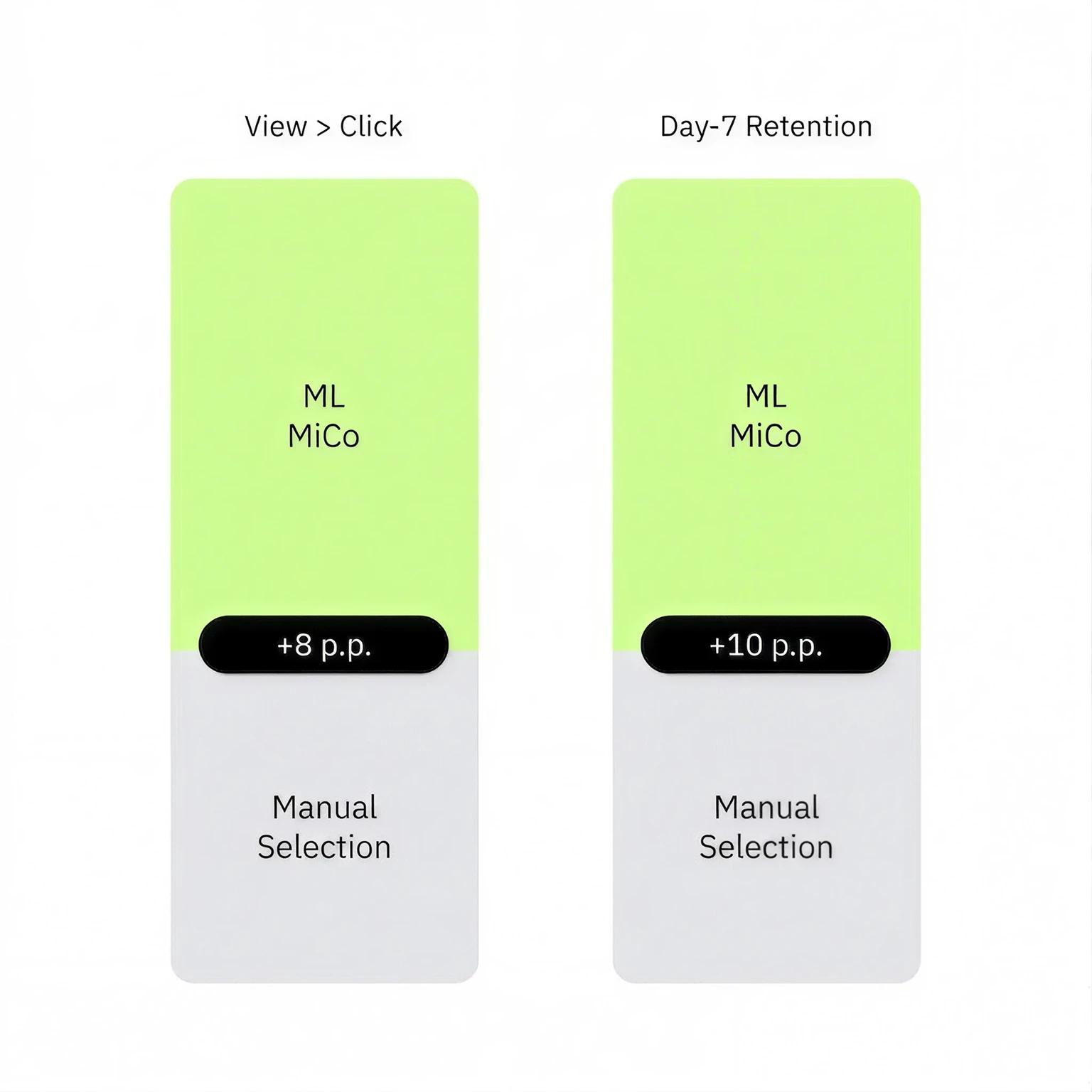
All metrics were calculated solely for the “Recommended Games” section; in other words, this represents the net effect of the change in the selection logic.
Behavioral metrics:
Financial metrics:
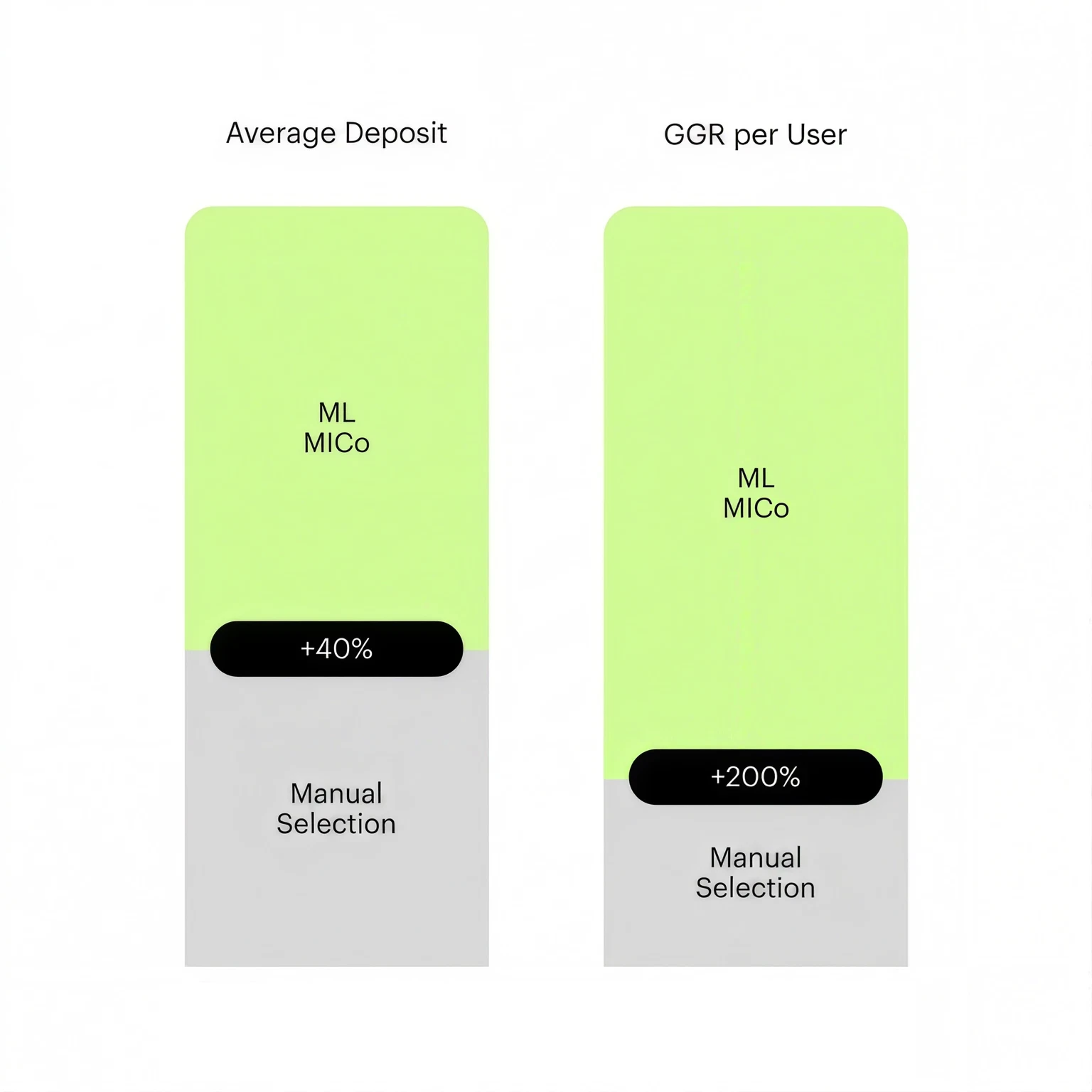
The results confirm that a recommendation section can be significantly more effective if the selection process is dynamic and based on players' actual behavior and preferences.
This case study illustrates a simple pattern: recommendations can be more than just a “convenient feature”—they can be a direct driver of revenue if they are adapted to the player’s behavior in real time.
Sustainable growth without increasing your budget. You don’t spend your budget on marketing or hire additional staff—yet your metrics grow because players are getting a more relevant experience.
Reduced manual labor. There’s no need to constantly update lists or allocate resources to do so. The ML solution does this automatically based on real-time data.
Scalability. The more players and events there are, the more accurately the model works. Recommendations can be used everywhere: in the lobby, in search results, in the game list, and even in communications.
The more touchpoints there are, the more noticeable the business impact.
Test the ML recommender on your own data:
Personalizing recommendations isn’t just a cosmetic improvement. It’s a sustainable growth channel that starts delivering results immediately after launch, without any additional marketing costs. The ML model replaces a static list with dynamic results that adapt to each player, and this has a tangible impact on revenue-related metrics.