



Recommendation System.
Personalized ML recommendations for growing retention and revenue across gaming platforms
At the meeting, we will discuss your objectives and demonstrate how predictive models work with data in real-life scenarios
We’ll send you an email notification so you can receive our newsletter
Stay informed. Get product updates, case studies, and practical ML insights for operators.


In most iGaming products, the recommended games section is generated in one of two ways: either it’s a list of the most popular slots on the platform, or it’s a selection curated manually by the operator’s team. Sometimes it’s a hybrid approach: some games are added manually, while others are selected algorithmically.
This approach is understandable and familiar. But it creates three key problems:
As a result, the set of recommendations does not consistently help increase retention, LTV, and revenue.
To achieve this, MICo (developers of AI and ML solutions for iGaming) integrated the MICo recommendation engine into the product of its client—a gaming operator. The ML model* analyzed each player’s behavior based on a variety of signals and generated personalized game selections.
Region:
South Asia
Audience:
250,000+ MAU
Point of entry:
The “Recommended Games” section, located in the operator’s lobby on the top level; this is one of the key navigation elements that receives a large number of views.
*ML (machine learning) — models that analyze data, identify patterns, and make decisions without manual intervention.
The effect was evaluated by comparing two operational scenarios:
Importantly, the design and layout of the block remained unchanged. No new mechanics were added, and traffic levels remained the same. The only difference was in the logic behind matchmaking.
The ML recommender generates a list of personalized recommendations on its own. Here's what happens:
Unlike manual curation, which relies on general statistics and past results, ML analyzes the behavior of a specific user and dynamically selects search results, eliminating the need to constantly manually update the list.
All metrics were calculated solely for the “Recommended Games” section; in other words, this represents the net effect of the change in the selection logic.
Behavioral metrics:
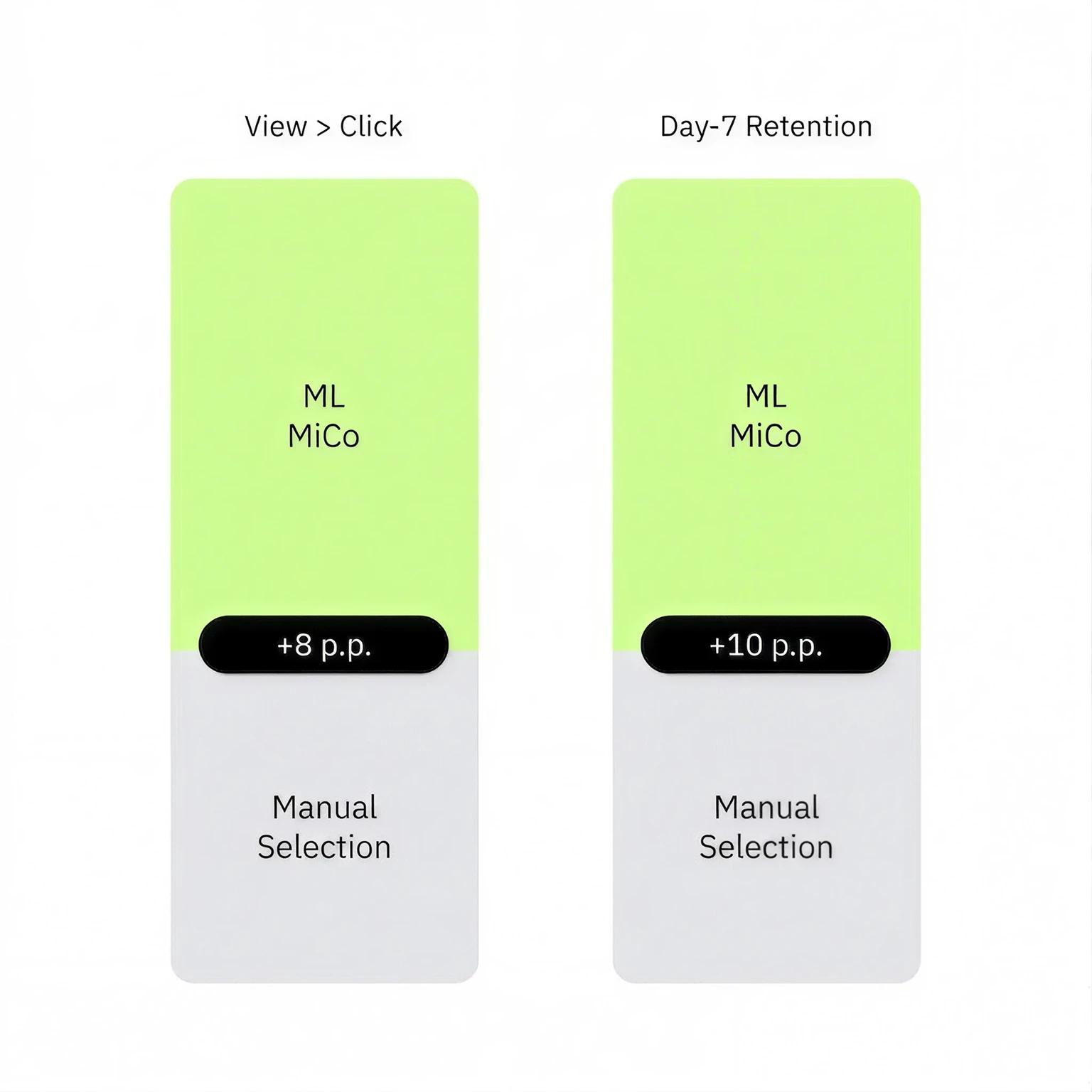
Financial metrics:
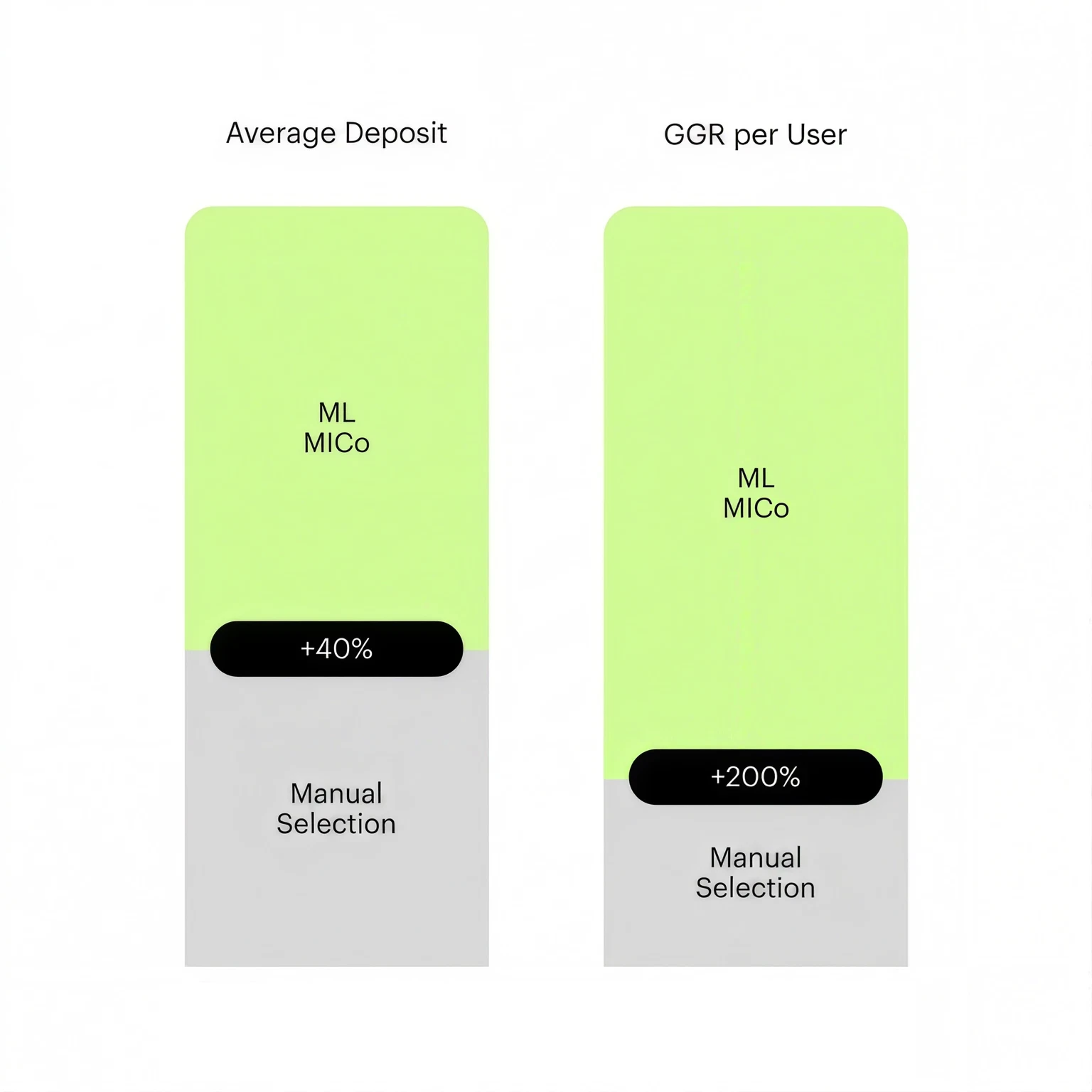
The results confirm that a recommendation section can be significantly more effective if the selection process is dynamic and based on players' actual behavior and preferences.
This case study illustrates a simple pattern: recommendations can be more than just a “convenient feature”—they can be a direct driver of revenue if they are adapted to the player’s behavior in real time.
Sustainable growth without increasing your budget. You don’t spend your budget on marketing or hire additional staff—yet your metrics grow because players are getting a more relevant experience.
Reduced manual labor. There’s no need to constantly update lists or allocate resources to do so. The ML solution does this automatically based on real-time data.
Scalability. The more players and events there are, the more accurately the model works. Recommendations can be used everywhere: in the lobby, in search results, in the game list, and even in communications.
The more touchpoints there are, the more noticeable the business impact.
Test the ML recommender on your own data:
Personalizing recommendations isn’t just a cosmetic improvement. It’s a sustainable growth channel that starts delivering results immediately after launch, without any additional marketing costs. The ML model replaces a static list with dynamic results that adapt to each player, and this has a tangible impact on revenue-related metrics.